The Egtved Girl: The 3,300-Year-Old Mystery of a Young Woman Preserved in Denmark
Imagine opening an ancient wooden coffin and discovering traces of a young woman’s life from more than 3,000 years ago.
Her clothing, hair, and personal belongings have survived through thousands of years of history. Although her body has largely disappeared, the objects buried alongside her offer an extraordinary glimpse into a forgotten world.
This is the remarkable story of the Egtved Girl, one of the most fascinating archaeological discoveries from the European Bronze Age.
A Remarkable Discovery in Denmark
In 1921, workers investigating a burial mound near the village of Egtved in Denmark uncovered something extraordinary.
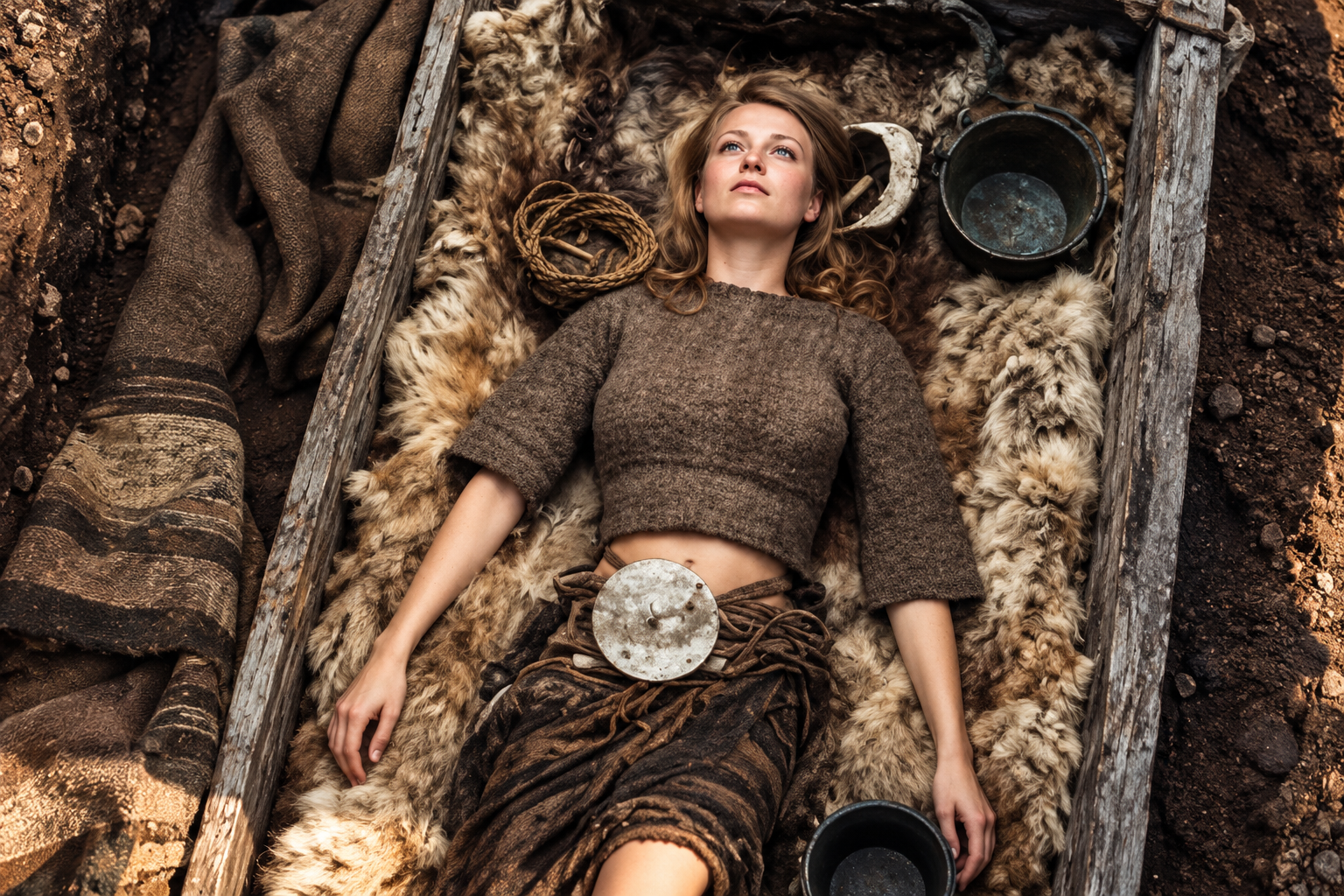
Hidden beneath the earth was an ancient oak coffin dating back to approximately 1370 BC.
Inside were the remains of a young woman believed to have been around 16 to 18 years old when she died.
Unlike many ancient burials, this grave contained remarkably well-preserved organic materials.
Her hair, woollen clothing, and several burial objects had survived for more than three millennia.
The discovery offered archaeologists a rare opportunity to understand how people dressed, lived, and honoured their dead during the Nordic Bronze Age.
The Strange Preservation of Her Remains
One of the most extraordinary aspects of the Egtved Girl’s burial was the condition of the materials found inside her coffin.
The oak coffin had been placed within a burial mound, where unusual environmental conditions helped preserve textiles and other organic objects.
Her clothing remained recognisable, along with her hair and traces of her body.
However, her bones had largely disappeared.
The acidic conditions inside the burial environment contributed to the breakdown of skeletal material while allowing certain other materials to survive.
This unusual preservation created an archaeological discovery unlike many others.
Instead of finding a complete skeleton, researchers encountered a collection of clothing, hair, and personal objects that revealed details of an ancient life.
The Ancient Outfit That Surprised Archaeologists
Perhaps the most famous feature of the Egtved Girl is her clothing.
She wore a short woollen blouse and a distinctive corded skirt made from twisted wool strings.
Around her waist was a belt decorated with a large bronze disc.
The outfit challenged modern assumptions about how people dressed in prehistoric northern Europe.
Rather than wearing only heavy, shapeless garments, this young woman had been buried in carefully crafted clothing with a striking appearance.
The bronze disc was particularly impressive.
Its decorative design suggested that metalworking and personal ornamentation were important aspects of Bronze Age culture.
Her clothing also demonstrated the remarkable skill of ancient textile makers.
Thousands of years before modern fashion existed, people were already creating distinctive garments using complex techniques and carefully selected materials.
Who Was the Egtved Girl?
Although archaeologists have learned a great deal about her burial, the young woman’s identity remains unknown.
Was she a member of an influential family?
Did she hold a special ceremonial role?
Was her elaborate clothing connected to her social position?
Researchers have explored these possibilities, but there is not enough evidence to establish her precise status or occupation.
The objects in her grave suggest that considerable care was taken during her burial.
She was placed inside an oak coffin with clothing and personal possessions, following traditions that were meaningful to her community.
These details offer a glimpse into how people expressed identity, remembrance, and respect during the Bronze Age.
The Mystery of Her Final Journey
Modern scientific research has added another intriguing chapter to the Egtved Girl’s story.
Researchers examined chemical signatures preserved in her hair, teeth, and clothing to investigate where she might have lived.
A study published in 2015 suggested that she may have travelled considerable distances and possibly originated outside present-day Denmark.
Some researchers proposed connections with regions of Central Europe.
However, later scientific work challenged aspects of those conclusions, showing that interpreting ancient strontium isotope evidence can be complicated.
As a result, her exact geographical origins remain debated.
What makes the question so fascinating is the possibility that Bronze Age communities were connected through networks of travel, exchange, and cultural interaction.
The Egtved Girl may have lived in a world far more connected than people once imagined.
A Small Child Was Also Buried in the Coffin
Another remarkable discovery was the presence of cremated remains belonging to a young child.
The child’s remains had been placed inside the coffin in a separate container.
The relationship between the child and the Egtved Girl remains unknown.
They may have been relatives, or their shared burial may have reflected ceremonial traditions that modern researchers do not fully understand.
The discovery raises questions about ancient beliefs surrounding death, family, and the afterlife.
Unfortunately, the people who arranged the burial left no written explanation.
Their intentions remain hidden in history.
What Her Burial Reveals About the Bronze Age
The Egtved Girl’s grave is important because it preserves evidence of everyday materials that rarely survive for thousands of years.
Her clothing reveals sophisticated wool-working techniques.
Her bronze ornament demonstrates skilled craftsmanship.
Her burial arrangements provide clues about funeral traditions and social practices.
Together, these objects help historians reconstruct aspects of life in northern Europe during the second millennium BC.
The discovery also reminds us that prehistoric communities were not simply struggling to survive.
They created beautiful objects, developed traditions, and expressed personal identity through clothing and decoration.
Many of their concerns may have been surprisingly familiar to people today.
Where Is the Egtved Girl Today?
The Egtved Girl’s surviving remains and burial objects are preserved by the National Museum of Denmark.
Her discovery continues to attract interest from archaeologists, historians, and visitors fascinated by prehistoric Europe.
The original burial mound near Egtved has also become an important historical location.
Although thousands of years separate her world from ours, the objects discovered in her coffin have made her one of the most recognisable individuals from the Nordic Bronze Age.
The Young Woman Who Became Part of History
When the Egtved Girl was buried around 1370 BC, nobody could have imagined that people thousands of years later would study her clothing, investigate her origins, and wonder about her life.
Her name has been lost.
Her voice can never be recovered.
We do not know what she dreamed about, whom she loved, or what she hoped to become.
Yet the objects placed beside her have survived long enough to tell part of her story.
Perhaps that is what makes this discovery so extraordinary.
She was not a famous queen whose achievements were recorded in written history.
She was a young woman whose life might otherwise have been forgotten completely.
And through an ancient oak coffin buried beneath the Danish earth, a small part of her world has returned to us.
More than 3,300 years after her death, the Egtved Girl continues to remind us that even the most distant human lives have stories worth discovering.