Introduction: The Night Everything Changed
Some secrets protect people.
Others destroy them.
For twenty-eight years, I believed my family was ordinary. We had disagreements, celebrations, old photographs, and Sunday dinners where everyone pretended everything was fine.
Then, one rainy evening, I discovered the truth that had been hidden from me since childhood.
And suddenly, every memory I had ever trusted seemed to have another side.
I thought the truth would break my family forever.
Instead, it taught me the hardest lesson of my life:
Forgiveness isn’t forgetting what happened. It’s deciding that what happened will not control who you become.
The Box in the Attic
It started with a box.
My mother had asked me to clean the attic before the house was sold. She was moving to a smaller apartment, and we had spent the entire weekend sorting through decades of belongings.
Old schoolbooks.
Christmas decorations.
Photographs.
Letters.
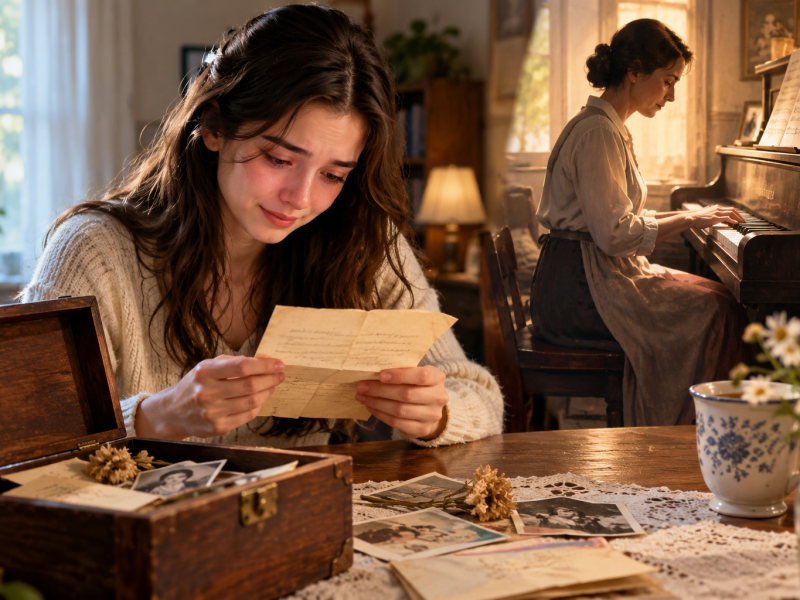
Then I noticed a small wooden box hidden behind a stack of blankets.
It had my father’s initials carved into the lid.
My father had died six years earlier.
I opened it expecting to find something sentimental.
Instead, I found a bundle of letters tied together with faded blue ribbon.
The first letter began with words that made my hands go cold.
“I don’t know how to tell her the truth about what happened before she was born.”
I read the letter twice.
Then a third time.
There was a name I didn’t recognize.
Daniel.
According to the letters, Daniel was my father’s younger brother.
My uncle.
A man I had never heard about.
The Family Secret
The letters revealed something even more shocking.
Daniel hadn’t disappeared.
He had been alive for years.
He had lived in another city after a terrible argument with my father. The family had cut contact with him, and my father had insisted that nobody mention his name again.
But why?
I kept searching through the box.
Finally, I found the last letter.
It explained everything—or at least enough to make me furious.
Years ago, Daniel had been blamed for stealing money from my grandparents’ business.
My father had believed him guilty.
Daniel had insisted he was innocent.
The argument became so bitter that Daniel left the family.
But the letters contained something my father had discovered years later.
Daniel hadn’t stolen the money.
The financial records had been falsified by someone else.
My father had eventually discovered the truth.
But instead of admitting his mistake, he had remained silent.
Pride had become more important than forgiveness.
And now I understood why Daniel had never come back.
The Person I Blamed
I confronted my mother that night.
She didn’t deny it.
She simply sat at the kitchen table with tears in her eyes.
“Your father wanted to tell you,” she whispered.
“Then why didn’t he?”
She looked down at her hands.
“Because every year he waited, it became harder.”
I felt betrayed.
Not just by my father, but by everyone.
How could they allow me to grow up believing my family was whole when someone had been pushed out and forgotten?
For days, I couldn’t think about anything else.
I stopped answering family messages.
I avoided my mother.
And most of all, I became angry at my father.
Even though he was gone.
Anger Can Become Its Own Prison
At first, my anger felt powerful.
I imagined confronting him.
I imagined telling him exactly what I thought.
But slowly, I realized something uncomfortable.
My father had already made his mistake.
I was the one continuing to suffer from it.
Every morning, I woke up angry.
Every evening, I went to sleep replaying a conversation that could never happen.
I was carrying a punishment that wasn’t mine to carry.
That’s when I understood that forgiveness wasn’t going to be about my father.
It was going to be about me.
Finding Daniel
My mother gave me an old address.
Daniel was still alive.
He was living in a quiet coastal town several hours away.
I almost didn’t go.
Part of me was afraid that meeting him would make everything worse.
But another part of me needed to know what really happened.
So one Saturday morning, I drove there.
His house was small, with a garden filled with white flowers.
When he opened the door, he stared at me for several seconds.
Then his expression changed.
“You’re your father’s daughter.”
I nodded.
“I know.”
He looked away.
For a moment, neither of us spoke.
Then he invited me inside.
The Truth From His Side
Daniel told me his story.
He hadn’t stolen anything.
He had discovered irregularities in the family business and tried to tell my grandfather.
Someone blamed him before he could prove what he had found.
My father believed the accusation.
Daniel left because he couldn’t bear being treated like a criminal by his own family.
“What hurt the most?” I asked.
He thought for a moment.
“Not being believed.”
His voice became quiet.
“I could have forgiven your father years ago. But he never asked.”
Those words stayed with me.
I suddenly realized that both men had been trapped by the same thing.
Pride.
My father had been too proud to admit he was wrong.
Daniel had been too hurt to return.
And decades disappeared between them.
The Letter I Never Sent
When I returned home, I wrote a letter to my father.
I knew he would never read it.
That wasn’t the point.
I wrote about my anger.
My disappointment.
My childhood memories.
I wrote about Daniel.
Then I wrote something I never expected to write.
“I forgive you.”
I cried after writing those words.
Not because everything was suddenly okay.
It wasn’t.
Forgiveness didn’t erase the damage.
It didn’t change history.
It didn’t make my father’s decision acceptable.
But something inside me became lighter.
For the first time, I wasn’t fighting the past anymore.
I was accepting that I couldn’t change it.
The Family Dinner
A month later, I invited everyone to dinner.
My mother came.
Daniel came.
For the first time in nearly three decades, the two brothers sat at the same table.
The beginning was uncomfortable.
Nobody knew what to say.
Then Daniel looked at my mother.
“I should have come back sooner.”
My mother reached across the table.
“You should never have had to leave.”
They both began to cry.
There was no dramatic speech.
No perfect apology.
Just two older people finally allowing themselves to grieve for the years they had lost.
Healing Doesn’t Happen All at Once
That evening taught me something important.
Family healing isn’t one big moment.
It’s a collection of small choices.
A phone call.
An apology.
A visit.
A willingness to listen.
A decision not to bring an old argument into a new conversation.
Over the following months, Daniel became part of our lives again.
We celebrated birthdays together.
We shared old photographs.
We told stories about my father.
Some stories made us laugh.
Others made us uncomfortable.
But we finally talked about them.
And talking made the secret smaller.
What Forgiveness Taught Me
I used to think forgiveness meant saying:
“What you did was okay.”
Now I understand that it means something completely different.
Forgiveness means:
- Accepting that the past cannot be rewritten.
- Releasing the need to punish someone forever.
- Allowing yourself to heal without denying your pain.
- Understanding that people can make terrible mistakes and still have moments of goodness.
- Choosing peace when revenge would only create another wound.
Most importantly, forgiveness doesn’t require forgetting.
I remember what happened.
I remember the pain.
But I no longer allow those memories to decide how I live.
The Mastery of Moving Forward
Months later, I returned to the attic.
The wooden box was still there.
I picked it up and smiled.
Once, that box had represented everything I hated about my family’s past.
Now it represented something else.
A lesson.
I realized that mastering life doesn’t mean controlling everything that happens to you.
Sometimes mastery means controlling what you do after something happens.
You cannot choose the secrets people keep.
You cannot change mistakes they made years ago.
You cannot bring back lost time.
But you can choose whether you remain trapped inside someone else’s mistake.
I chose to move forward.
A Different Kind of Legacy
Today, Daniel still visits us regularly.
My mother keeps an extra chair at the dinner table.
And sometimes, when we’re all laughing together, I think about the years we lost.
I wish they had never happened.
But I also know that wishing cannot change the past.
What we can change is what we do with the time we have left.
Our family secret once divided us.
The truth brought us pain.
But forgiveness gave us another chance.
And perhaps that’s the real art of forgiveness:
Not pretending the wound never existed, but learning how to live beautifully after it heals.
Final Thought
Sometimes life doesn’t give us the family story we wanted.
Sometimes it gives us broken pieces.
The real challenge is deciding what to do with them.
We can hold them tightly and let them cut us.
Or we can carefully put them together and create something new.
I chose the second path.
And for the first time in my life, I understood that letting go wasn’t losing my past.
It was finally becoming free from it.